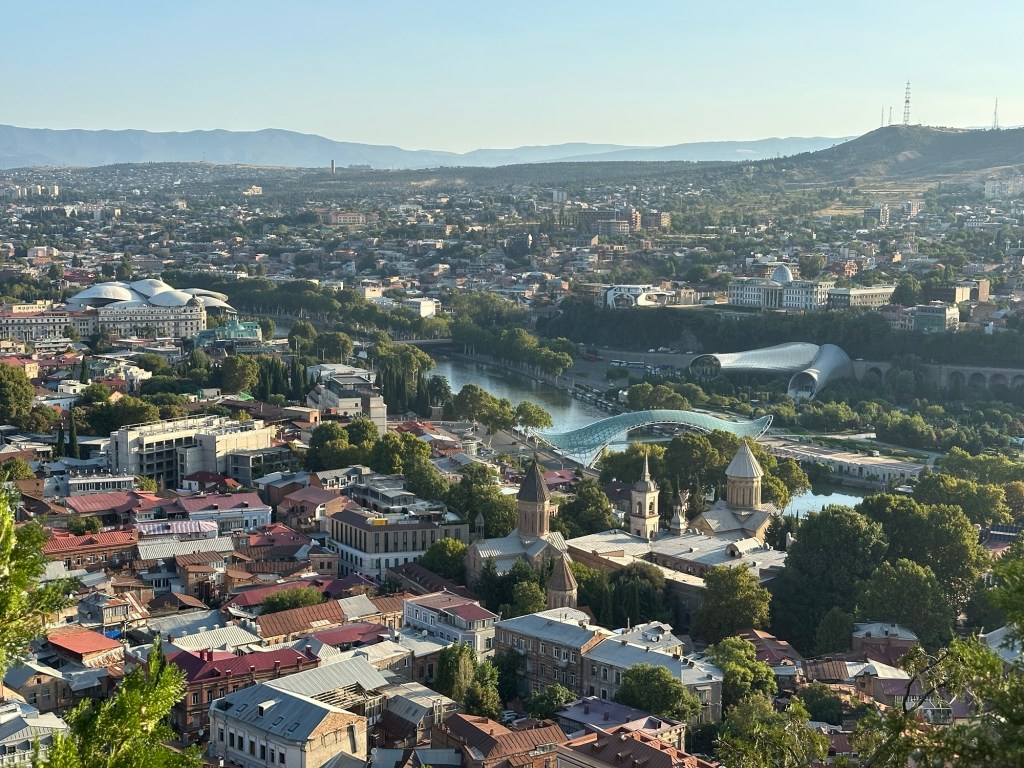
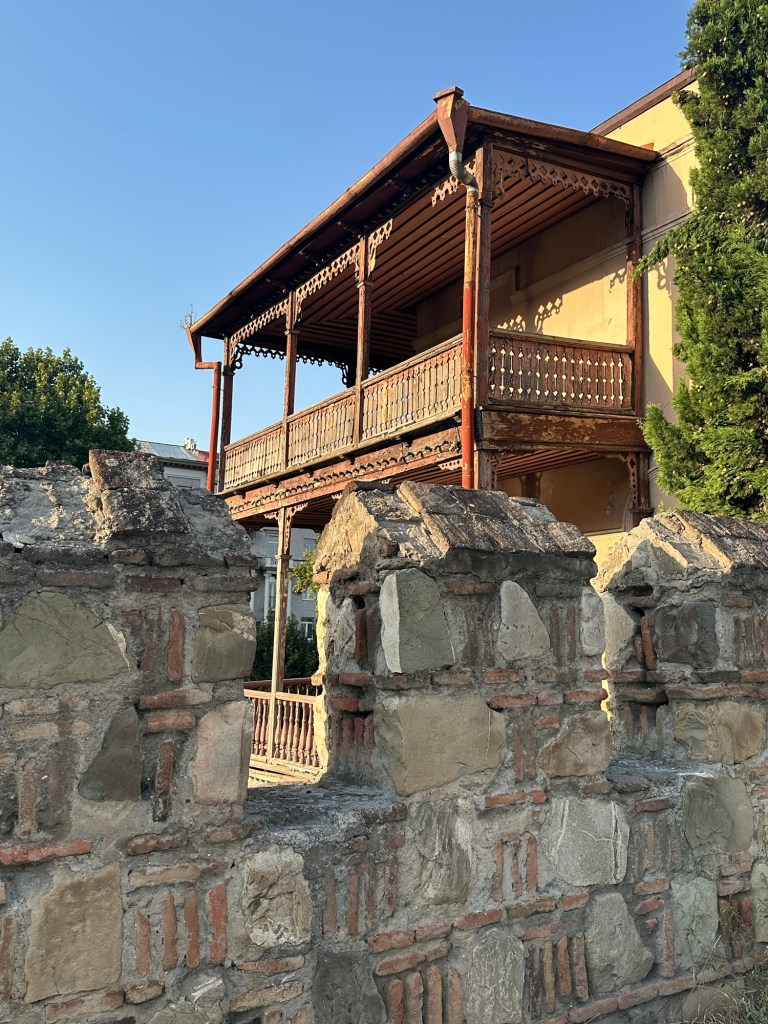
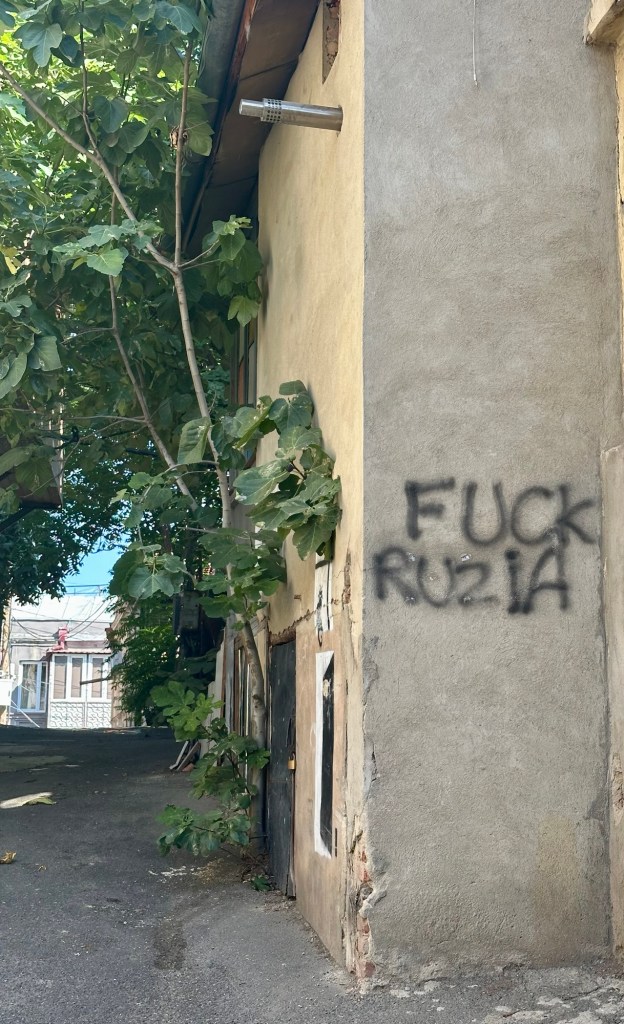
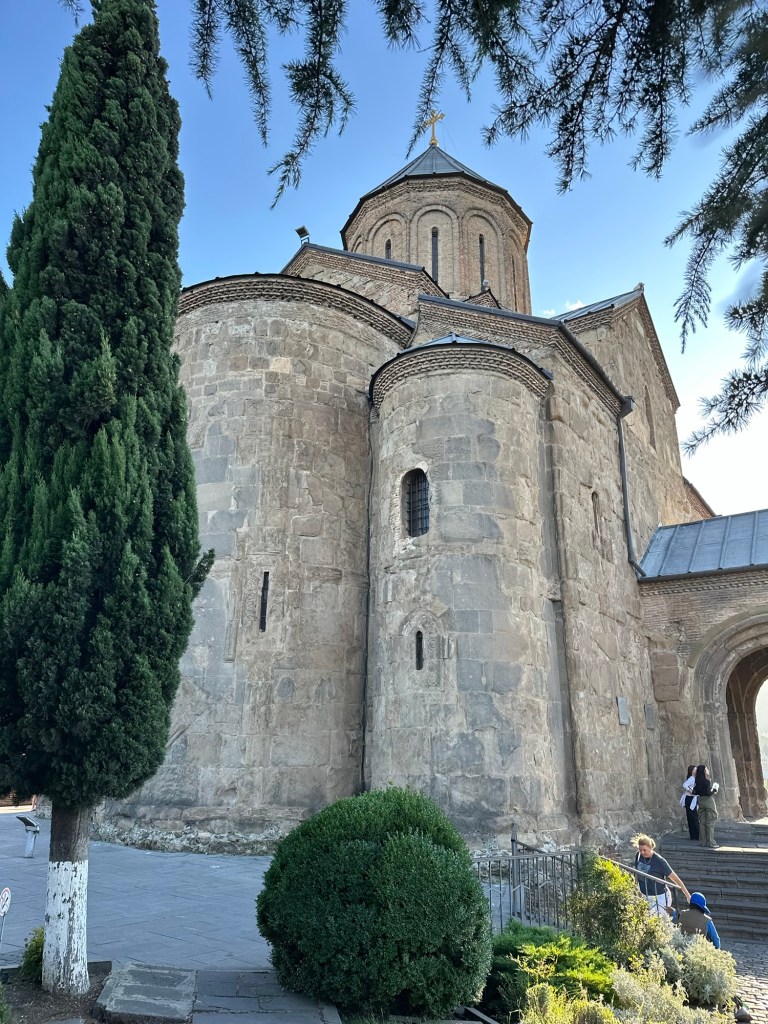
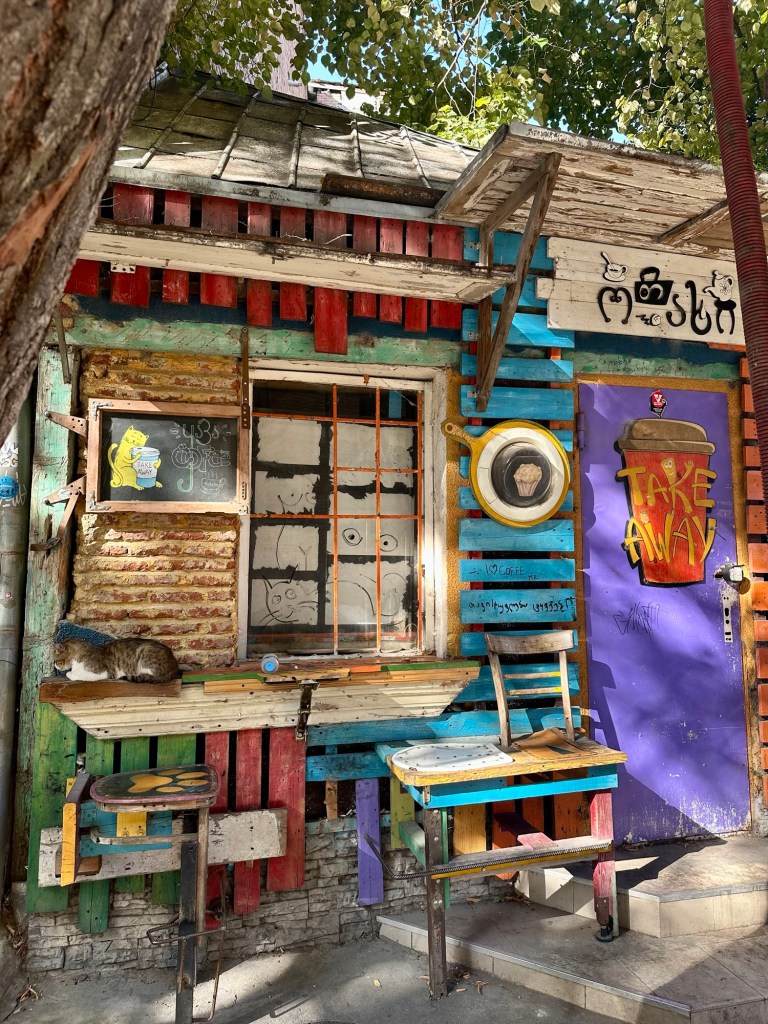
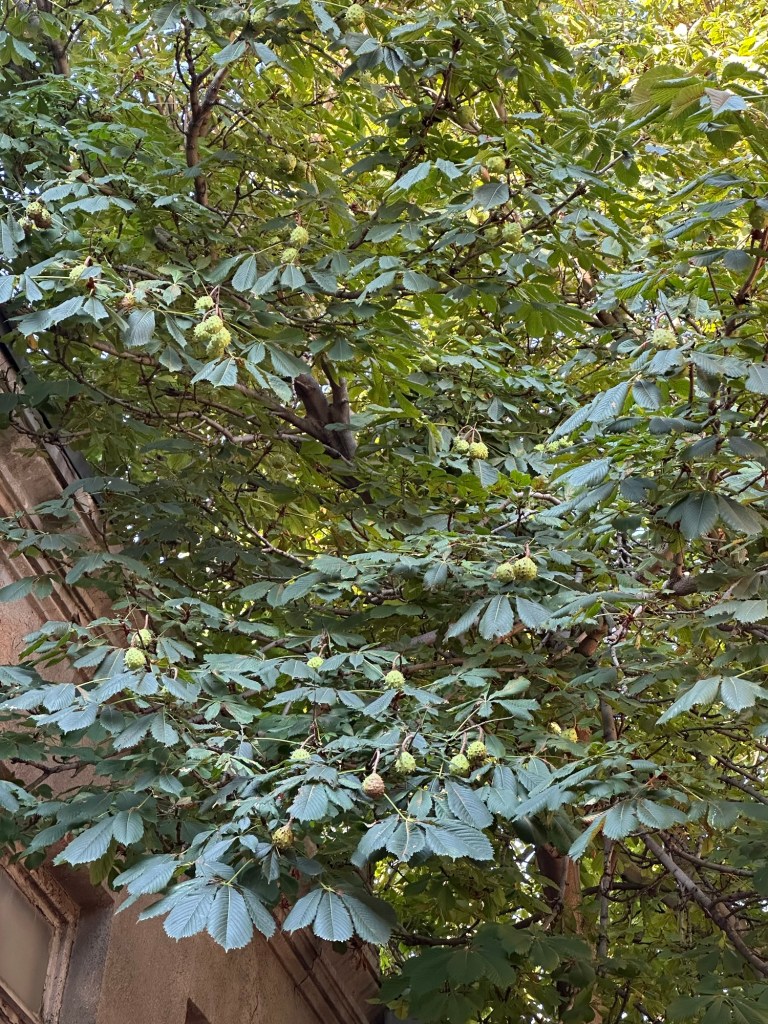
When I think back about Tbilisi, I may remember fat, green figs ripening on trees; wooden balconies decorated with elaborately carved lattice work that often dangled precariously; an abundance of cat and anti-Russian graffiti painted on doors and drab concrete walls; small Orthodox churches stuffed with gold icons, flickering candles, and fervently praying faithful.

And I hope I’ll remember a feeling of welcome and calm even though I was traveling completely alone.
Georgia (or as I tend to say, “Georgia, the country not the state”) sits wedged between Russia, Armenia, Azerbaijan, and Turkey. It’s the birthplace of Josef Stalin, playground of the Soviet Union, and periodic target of Russian invasion. Historically, the capital, Tbilisi, was a stop on the Silk Road linking Persia and points further east to the broader Europe.

All of this is evident in the variety of cuisine, underground bazaars, diverse nationalities of tourists, ancient sulfur bath houses, and mix of crumbling infrastructure and block housing.

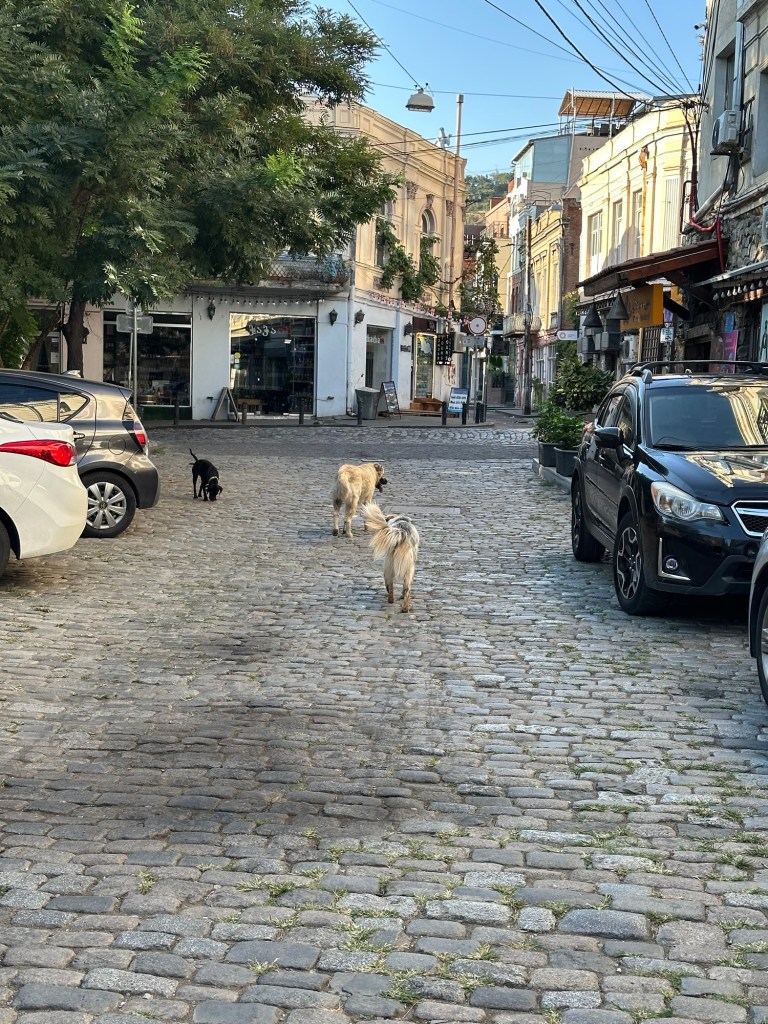
But what I’ve loved most has been wandering the old town amidst dogs and dereliction. That part, I’m quite sure, I’ll never forget.
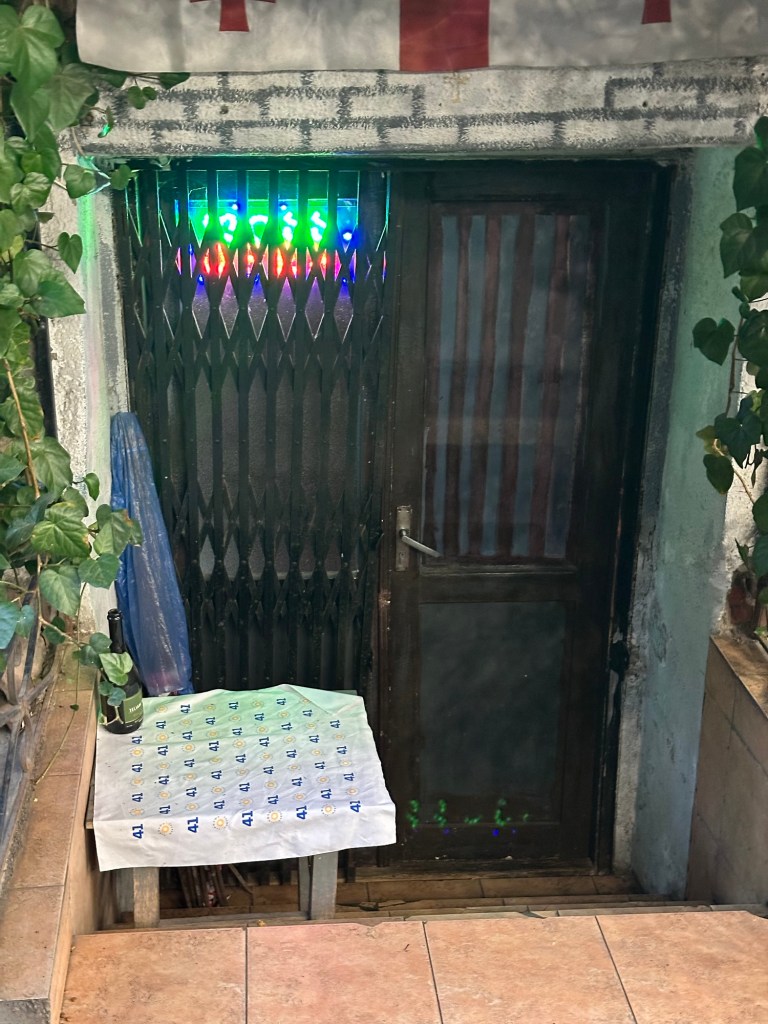
The first night, I arrived at my hotel shortly past seven in the evening and set off to find a place to eat. I hadn’t gone far before I noticed a blinking neon sign in a window below grade level. It was illegible to me with its curlicue Georgian characters. Unsure what to expect, I descended the stairs and opened the door to find a charming restaurant filled with, what appeared to be, happy Georgians.
A woman indicated a two person table against the wall—the last unoccupied spot.
“Credit?” I asked.
“Only cash,” she replied.
“I held up one finger. I’ll be right back,” I told her.

But getting cash in Georgia proved more daunting than I expected. On every street I found at least one ATM-like machine, but these apparently sold lottery tickets and accepted payment for utility bills among a myriad of other things. A concierge in a hotel on Liberty Square directed me to an ATM tucked in the back room of a currency exchange agency. Throughout the rest of my stay, this was the only functioning ATM I ever found, but alas, I had lari.
I was gone maybe 20 minutes, and when I returned a man had occupied my table. The woman looked at me in dismay, searched the room for a nonobvious solution, and then raised her finger in a gesture of Eureka!
In the corner, a tiny, round folding table—the sort we had on our minuscule Budapest balcony wedged between café chairs—was covered with a fruit display. She removed a bowl of peaches, a cluster of grapes, and random wine goblets and set it up as a table for one.
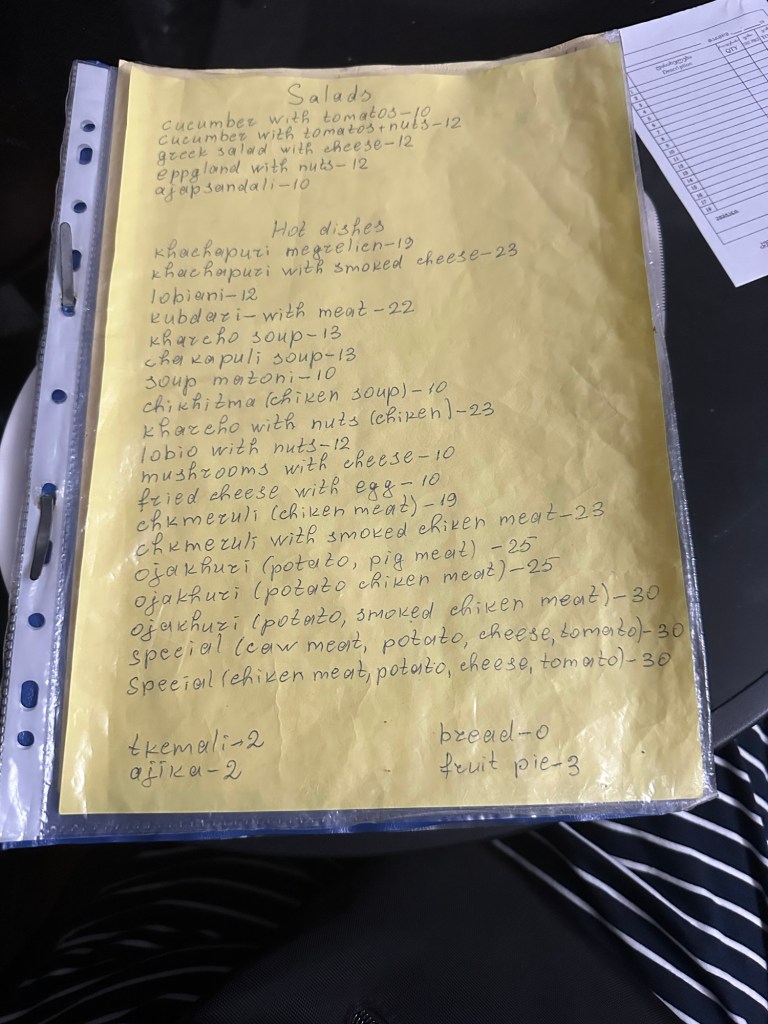
A man, who I assumed was her husband, handed me a handwritten English menu and a paper ordering slip. “Write down,” he told me, and I did as directed. Dinner was a delicious casserole of chicken, tomatoes, and potatoes in a thick broth. Occasionally when the man walked by, he patted my shoulder in a comforting gesture of welcome. I took it he spoke almost no English, but we got by.
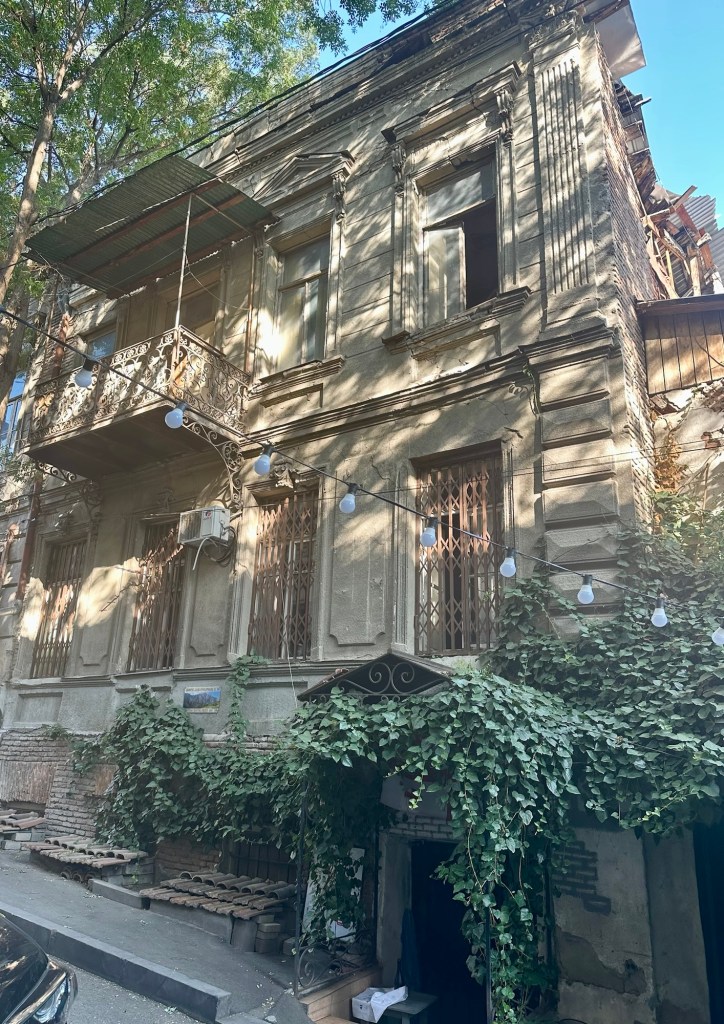
The next morning in the light of day, I passed the restaurant and wondered why I had ever selected this place. The rest of the building was abandoned, and on the restaurant end the roof had caved in. And yet, as I write this on my final day in Tbilisi, it is one of my favorite memories from the trip.
This, and the ubiquitous dogs.

Passed out in the sun, playing with other dogs, crossing streets only after the walk sign illuminates in a bizarrely human fashion—most of them had metal ear tags which I read online indicates that they are strays which have been neutered and vaccinated. As a person who once planned to work with dogs, I wasn’t sure how I felt about this. Yet throughout the city, I passed buckets of water and piles of kibble set out for the strays. Since streets have very little traffic, it seems a workable solution. All I can say is, the dogs appear friendly and happy.
I’ve spent nearly all my time walking through crumbling neighborhoods, saying “good boy” to a litany of adorable strays, and eating in places that felt like they were one bad day away from rubble. It’s been simultaneously challenging, interesting, and restful; I’ve placed very few demands on myself.

After sharing my thoughts about Tbilisi with a friend, she asked if I’d return. While I’m glad I came, I’d say it’s doubtful. I texted Pat yesterday and told him, “Let’s agree to only travel within Italy and France.” How many times have I sent that text over the last ten years? And how many more times will I send it?
(Update: After reading this post, Pat said, “I really want to go there. Would you go back?”)

Now after a week in Tbilisi, I’m returning to Paris. I decided to jot this down quickly over breakfast lest I forget this place. Soon I’ll be busy: back in Paris writing an essay for my class, seeing friends, ultimately flying to Michigan for a few weeks to meet up with Pat before driving to Philly and then returning to France.
In this pause, I want to capture this trip. Come tomorrow, I’ll be gone.
More photos:






Discover more from The World In Between
Subscribe to get the latest posts sent to your email.
Categories: Other places
 The World In Between
Thanks for the post. My neighbor lived in Tblisi for 4-5 years. He came back from there with several dogs!
LikeLike
I was told that adopting dogs and bringing them back is quite common. They were just about the chillest group of dogs I’ve ever seen! I can imagine he grew close to some. Good for him!
LikeLike
Hi Julie,
I really really love reading your posts. I have been in Georgia when I was a little girl (I am from Ukraine, last 35 years in Canada).
The picture where you say it’s figs are a chestnut tree. Lots of them in Kyiv along the streets.
But I do remember seeing figs and eating right in the street in Crimea and in Sukhumi.
All the very best to you! I wonder if O could ever dare to live this kind of lifestyle… may be 🙂
Gene
LikeLike
Oh my. What a lovely comment. Thank you!
I had a real fig picture, but I didn’t grab it! 🙄 Women sell figs on the street in Tbilisi also. I ate a big bag of them when I was there!
If you can relocate half way around the world into a place with a completely different language, I’m pretty sure you have the strength to do most anything. You must have amazing stories to tell.
LikeLike
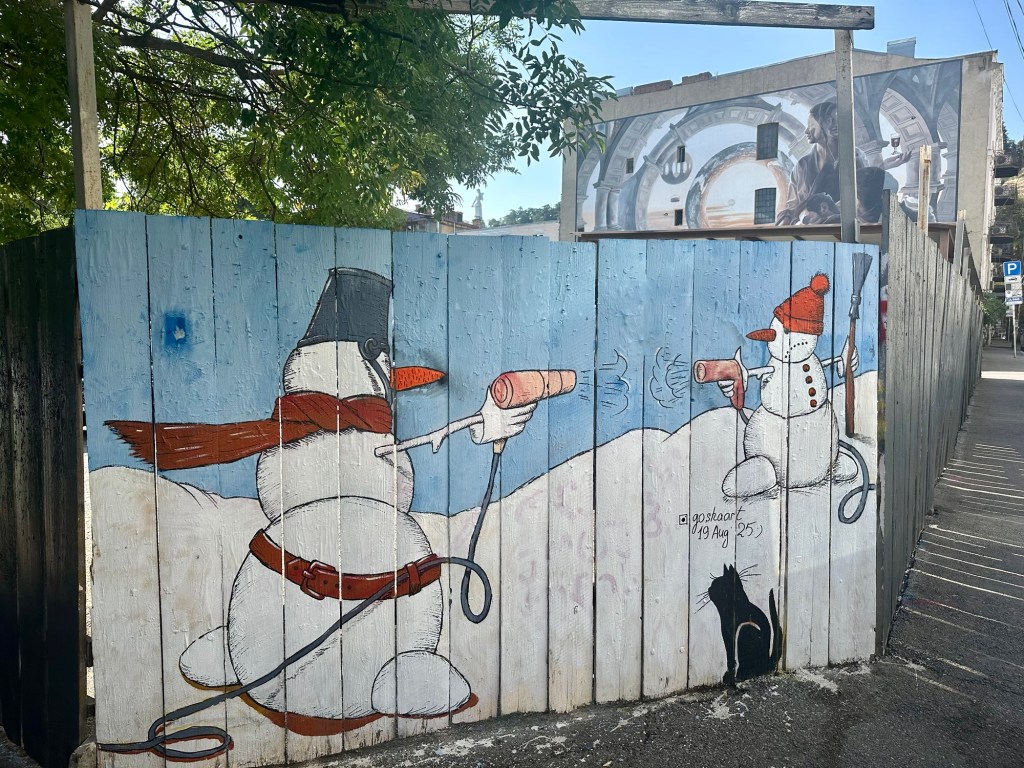
Looked like an interesting trip and experiences for you….Beauty in many different ways, the people, the food, the city, the art, the humor…. 2 snowmen battling it out with hair dryers!
looking forward to your writing about it later, comparing with some of your other travels
Thank you, say hello to Pat .
Bob Z. In Evergreen
LikeLike
Thanks Bob. Pat sends his best back. I do love those dueling snowmen!
There is certainly a thread across the post Soviet states. Tbilisi had the most dilapidated buildings. The only comparable compare I can think of in my travels is Havana. I wish I could go back in 100 years and see their progress.
LikeLike
A memorable experience and no-pressure stay; sounds good to me.
LikeLike
Those are the best. I sometimes think I’m a bit too good at no pressure stays!
LikeLiked by 1 person
the kindness of people around the world who have basically nothing but share what they have is comforting.
I do believe that your last picture of what you call figs are actually chestnuts.
LikeLike
I read a quote recently about the value of kindness from people who have so little. It was this exact thought. I need to find it.
And yes, thank you! I’ve added my fig photo. I bought a bag of green figs there; little old women were selling them everywhere. I eat a ton of figs this time of year Maybe I need to stop ignoring those “it’s time for your eye exam” messages I’ve been getting. 😂
LikeLike
Hi Julie, where did you stay?
we have been to this lovely city a few times, and coming back this fall to meet with family
LikeLike
How nice, Milena. There are tons of great looking Airbnbs. Since I was alone, I stayed at a boutique kind of hotel (The Blue Fox). It was great, but if I knew the city…. I’d probably find an apartment in my favorite neighborhood.
LikeLiked by 1 person
Thanks Julie, that’s good to know
LikeLike