
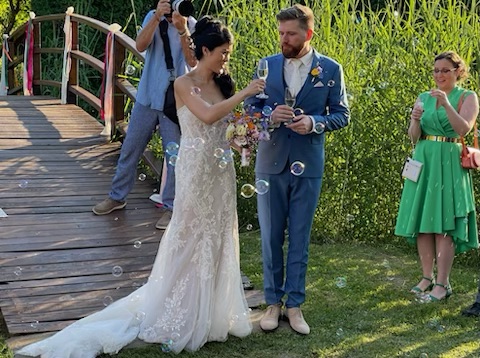
The bride and groom walked to the alter holding hands while friends gathered by the river bank. Some sat on benches but most stood. The officiant asked the couple questions about how they will handle some specific life challenges.
As they answered, he placed stones and pebbles and sand into a jar symbolizing the large, medium, and everyday realities of a long marriage. He speculated about a “far distant future—after as many as fifty years of married life.” He made it sound as though fifty years ago dinosaurs roamed the earth.
I whispered in Pat’s ear, “They’ll be surprised how quickly it goes.”
Half of the sand, the officiant explained, had come from the Danube banks of the groom’s home country of Hungary and the other half from the beaches of the bride’s home country of Singapore. The service itself was on the banks of a small river in rural Hungary an hour by train and foot from Budapest.

We had come here quite unexpectedly. Our trip to Paris was already set when we were invited to “a traditional, rural Hungarian wedding.” The groom was my pig-killing friend, Abe. I mentored him at IBM; he conjured some of my life’s great memories. It took me seconds to commit and a few hours to delay our return home and formulate our travel plans.
Once we arrived in Budapest, we went out to dinner with former neighbors and good friends. They told us—warned us—of what constitutes “a traditional Hungarian wedding.” Essentially it’s a food and booze fest that ends sometime after sunrise and includes limbo competitions, a bride kidnapping, and a near lethal amount of palinka.
“Julie, if you’re still there at 4AM, you can’t be sober,” our friend warned.
I had a foreshadowing of this when Abe told me that the wedding would be at 5 and shuttles could take us to back to Budapest from midnight until 8AM. And I remembered the staggering amount of palinka consumed on a Hungarian farm as we processed the pig.
Few things are more stressful to me than shots of palinka and staying up past 10PM. As a mitigation strategy, I snagged the last hotel room at the wedding venue in preparation for a pre-midnight escape. Then I read the wedding FAQs that Abe had sent: We hope that everyone can stay until at least midnight.
“It’s a plot to kill me,” I told Pat.
But it turns out that my reaction was unwarranted. I had forgotten how quickly time passes at a truly great wedding reception. As the night progressed, I realized that I had attended this reception so many times before.
When we were young and all my husband’s Irish and Polish friends got married right out of college (or in some cases high school), the receptions were generally held in unglamorous locations and fueled by a ridiculous amount of food and beer. The families were enormous. The nights were raucous.
It was a world far removed from vineyard weddings and destination weddings and other flavors of black tie affairs.
These weddings were held in church halls or community centers. They were either simply catered or friends, family and church folk provided a pot luck. No one drove off in a limo. If tuxedos were involved, no one expected to get their security deposit back. And of course, nothing—thank goodness—was posted on social media.
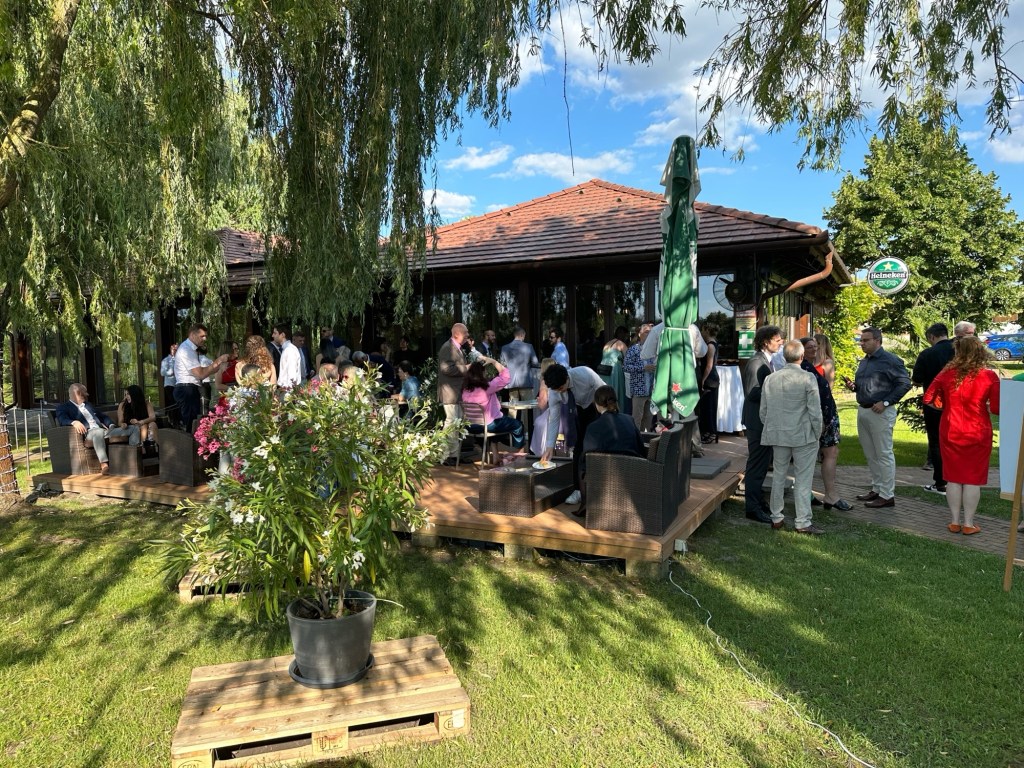
This hyper-connected world which awaited us was still blissfully inconceivable. It was a time when “friends” were those people who called you regularly, made a casserole when someone was sick, and attended the ceremonies associated with life-altering events. It was a world of penny loafers and JC Penney suits.
I sometimes miss that world.
But here in this new world, the celebrants came from everywhere. At our table, there was a man from Colombia, another from Australia, and a woman from England. I met a man from Cyprus who was there with his Chilean wife. Many of the global contingent work with Abe in Switzerland. Some grew up with the bride or knew the couple when Abe worked in Singapore.

It was a wedding that coalesced 45-year-old memories with those of the last 13 years. Simple times. A United Nations of friendships. New traditions.
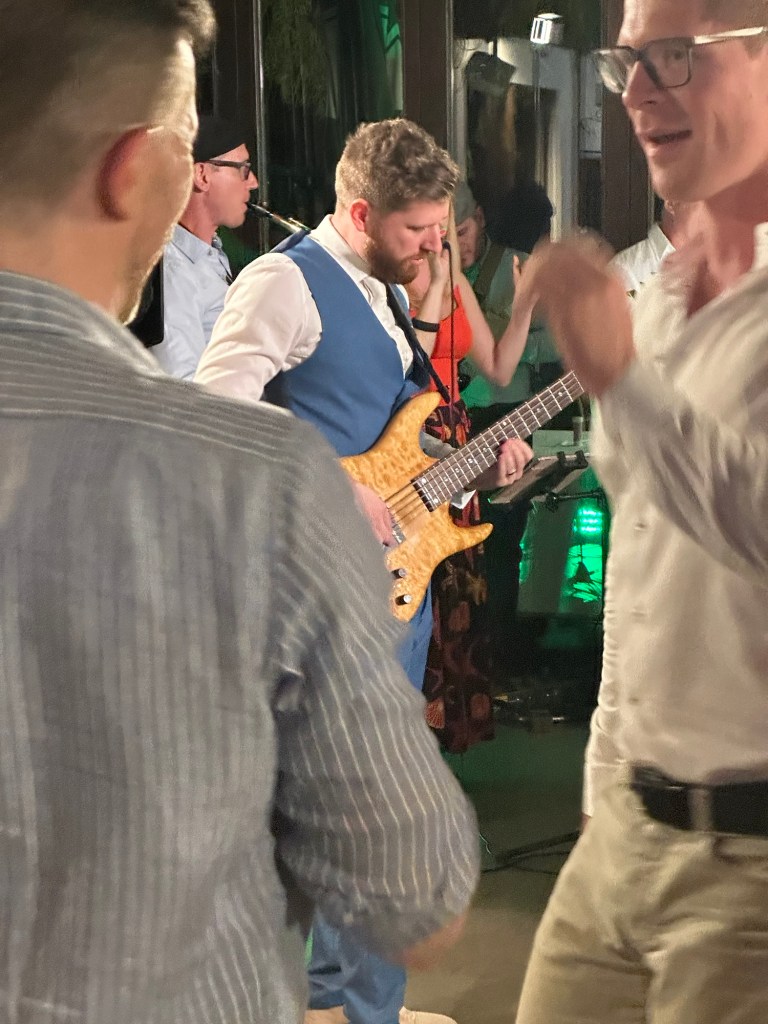
We ate pork loin and sauerkraut, and then the band started up. The first song was Earth Wind and Fire’s September, and Abe played the bass. The dance floor filled. From there, we jumped into Twist and Shout.
It was Monor, Hungary. It was Bay City, Michigan. It was amazing.
Nearing midnight, the bride changed into her Singaporean wedding dress to cut the cake. Abe joined the Swiss drum corps as they marched into the venue and performed (one of the drummers had driven from Switzerland with the gear). The bride sang a Hungarian folk song—in Hungarian! Time and again, Abe strapped on his bass guitar and joined the band.
I thought back to the cocktail hour before the ceremony when a woman took our photos with a Polaroid camera. I waved the print in the air as a ghostly image emerged and then taped it into a book with all the other photos and handwritten snippets of congratulations and marriage advice.
As I considered what I should write, I thought about this moment and everything that conspired to bring us here. My advice was short: Do it all. Especially the crazy stuff.
At one o’clock, we were the second couple to leave the party. The bride had not yet changed into the traditional Hungarian red dress. The midnight breakfast had not yet been served. But for me, the night had been perfect.
We walked back to our hotel room with no light save that of a near-full moon. A soft breeze blew off the river. The sounds of the party grew faint. Pat said, “That was a great night. I’m so glad we came.”
“Me too,” I replied.
Discover more from The World In Between
Subscribe to get the latest posts sent to your email.
Categories: Central/Eastern Europe, Ruminations
 The World In Between
I love it! So much fun – more fun than modern weddings, which I try to avoid at all costs. 😀
LikeLike
It was wonderful (and I so agree with modern weddings!)
LikeLike