Monango, North Dakota is a desolate place. Why my great great grandparents James Holloway and Charity Bird Holloway decided to homestead there, I’ll never know. But in my mind, it raises the coolness factor of my family dramatically.
I grew up on their son’s farm in Allenwood, New Jersey. For five generations, Holloways married, packed their bags and moved next door. Outside of my immediate family—my parents and sister—I don’t remember anyone ever spending a single night away from the farm.
Simply put, our name was not synonymous with intrepid. Then in 2015, I learned that these homebodies hailed from homesteaders.
In a prior blog, I explained how I discovered this. I won’t repeat it here.
Here, I’m going to focus on our road trip this September that detoured through Monango, North Dakota, population 35. This is a town founded by a trio of men that included my great great grandfather. It’s where my great great grandmother died giving birth to her sixth child and where her bones are somewhere buried.
Prior to our trip, my son Ryan had dug through land records and found the plot number of James Holloway’s land acquisition filed with the Bureau of Land Management, but there was no corresponding map. He went off to Monango and unsuccessfully searched for Charity Bird’s grave and spent some time talking with a member of the Dickey County Historical society but found little except dead ends.
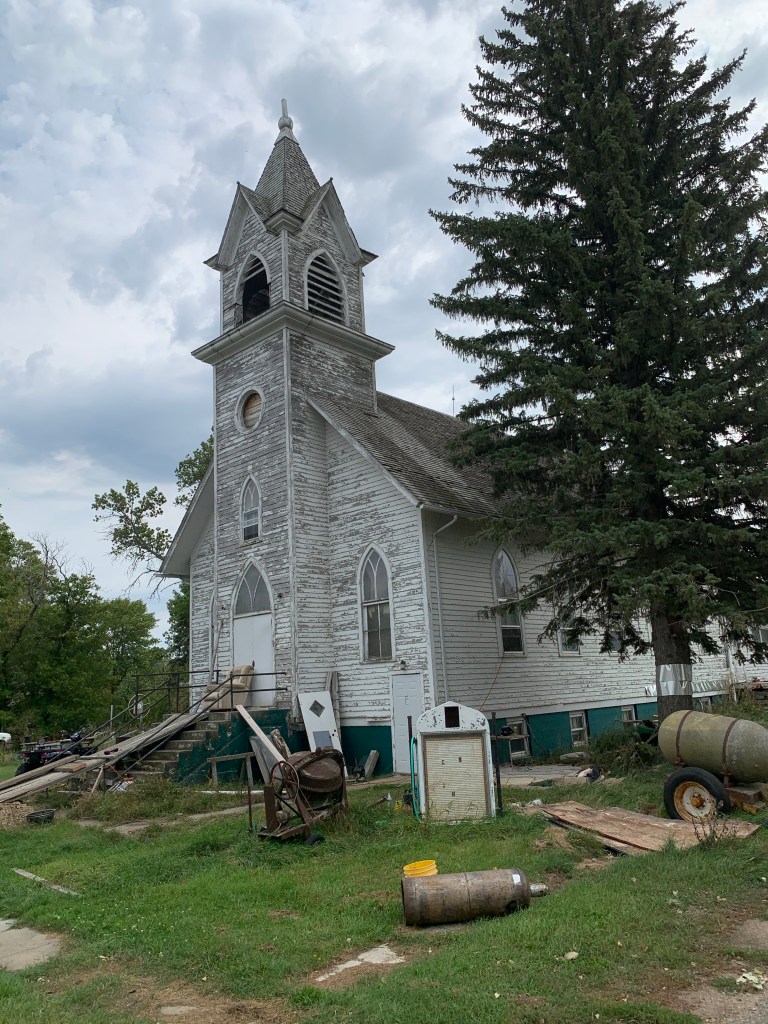
Pat and I arrived in Monango mid-afternoon with a simple objective of seeing the town and looking for the burial site ourselves. The town is a four by four grid of short roads dotted with nondescript houses next to a dilapidated church, not unlike many ramshackle towns strewn across rural American and built on dead or dying industries. We poked around for 15 minutes before heading a mile out of town to the Monango cemetery.
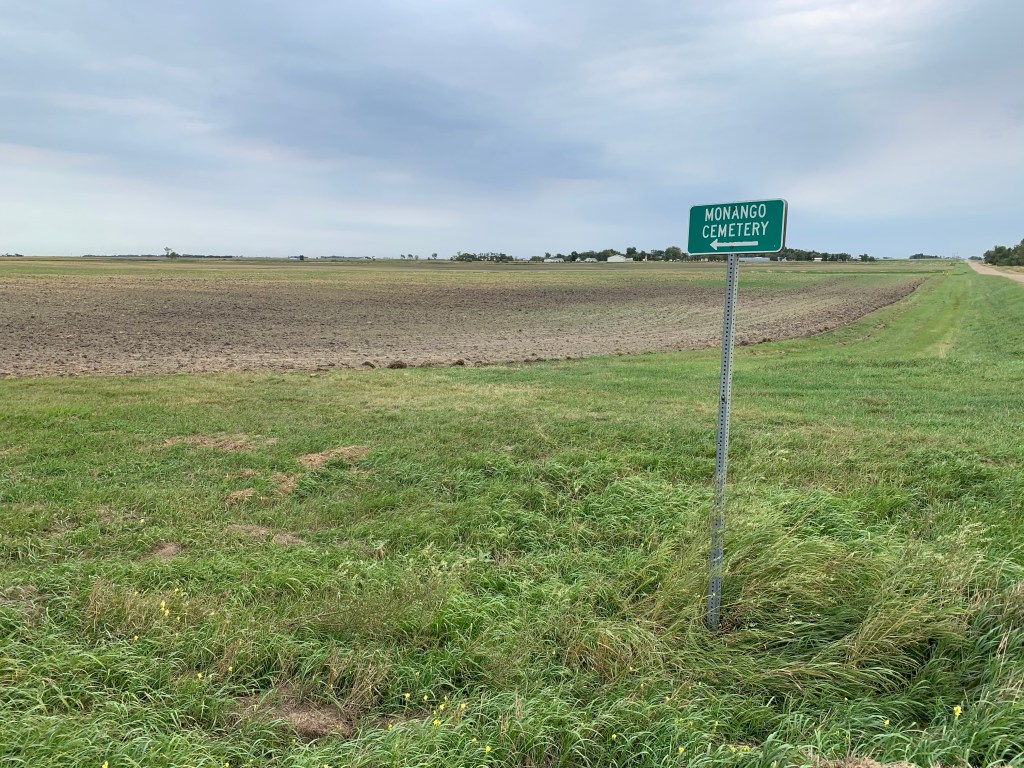
A sign pointed us down a grassy lane to a copse of trees bordering a field that contained a few hundred unadorned headstones. We walked every row and checked every name. The oldest stones dated a few years after Charity’s death in 1886.
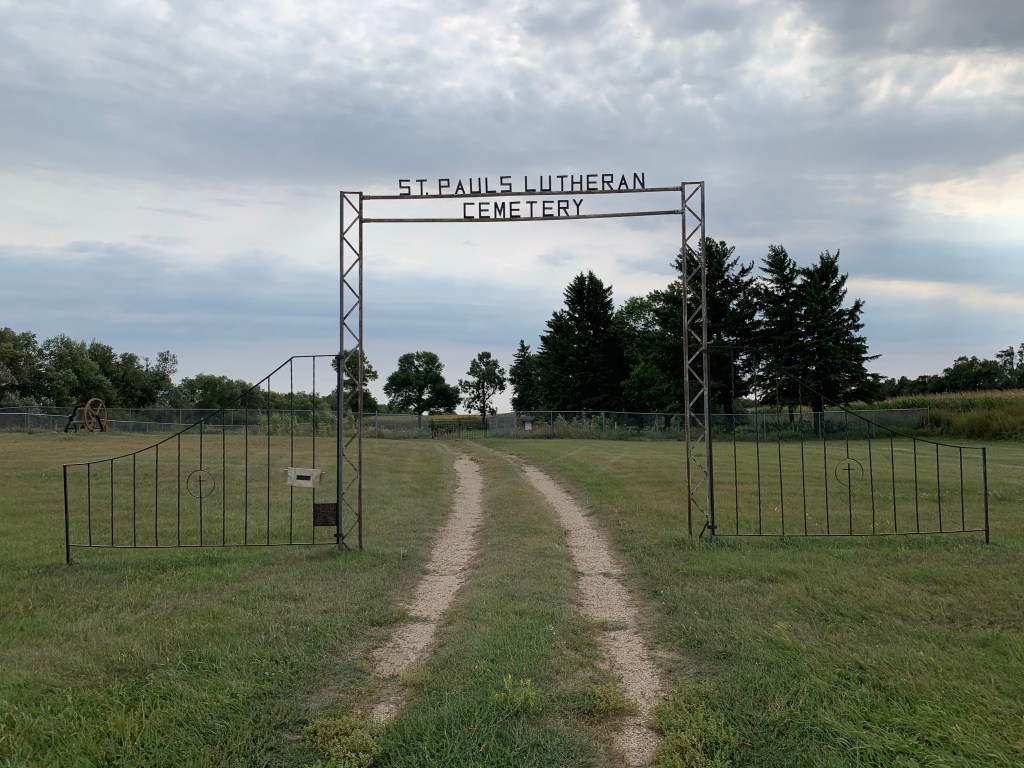
A few miles further, we stumbled upon a Lutheran cemetery and again, we checked the name on every stone. Confident that she wasn’t in either of these cemeteries, we decided to return to town for one final look before heading onto Bismarck for the night.
It was then that we spotted a woman working in her garden. Since arriving in town, we had seen neither man nor beast, so we decided to stop and talk.
She was a farmer’s wife, by my best guess in her 70s, and by all indications unfazed to be approached by strangers on a remote stretch of gravel road. Her “husband’s people” were from these parts, she told us. Her knowledge of Monango ran deep. I gave her a summary of my quest. She tilled potatoes the entire time we talked.
In her estimation, Charity Bird was most likely buried on her farm and most likely in an unmarked grave. Prior to statehood, records about deaths in the Dakota territory were not mandatory and therefore spotty at best. Often churches were the best source of information, but the church in Monango was a dead end.
When I mentioned we found no record of James Holloway after he took his children back to New Jersey and returned to Monango, she theorized that he may not have lasted, “Life was hard here. Many left, only a few stayed on.”
Lastly, I asked if she knew the plot number layout of the area. “Of course,” she replied. I gave her the number of the Holloway farm, and she rattled off directions. She told us this particular plot had been further subdivided in more recent years. We thanked her, got back in our car and turned towards the farm.
The gravel roads outside of Monango are arranged in a checkerboard that segregates massive stretches of nothingness. As Pat drove, I texted Ryan: WE FOUND THE FARM!!!
The plots were sizable, the sort of farms traversed in pickup trucks. Circa 1950s homes squatted in clusters a few hundred yards from the road down paths that meandered through the North Dakota grasslands. The fields appeared untilled for years. Outbuildings slouched from age and wind. I saw no lights, dogs, cars or other signs of habitation, just a jumble with no distinguishable boundary between one piece of land and the next. I couldn’t envision what a farm would have looked like 125 years ago, but I could now visualize the sheer barrenness.
Pat asked if I wanted to go up and knock on a door, but any inkling of my family had been erased. It was enough to stand still and listen to the unrelenting wind.
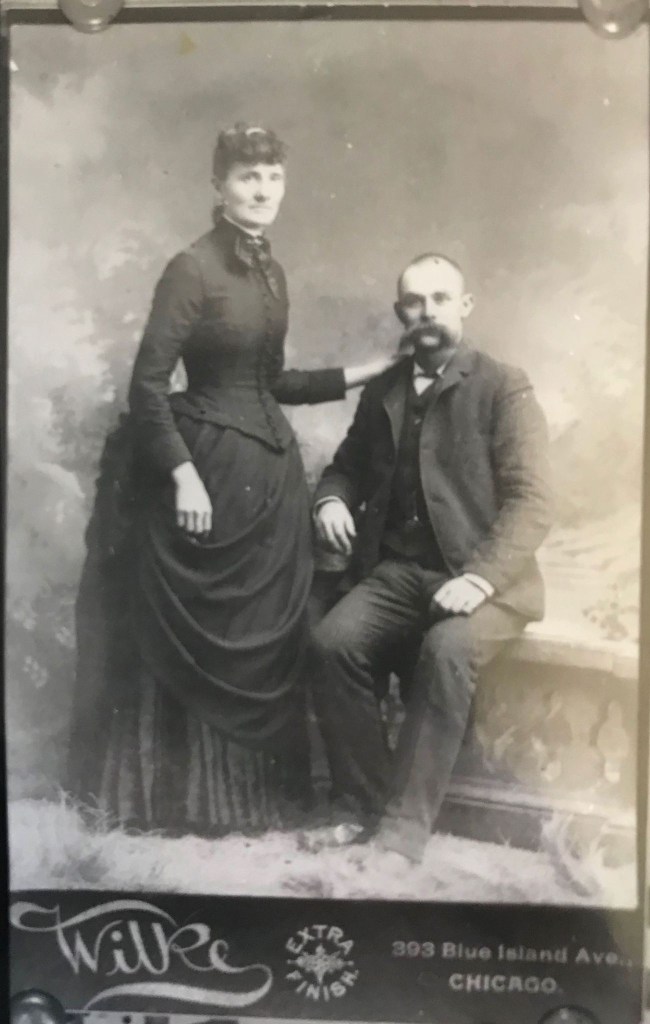
Since writing the original post, two of Charity Bird’s family members have reached out to me. Each of them has given me a few more pieces of the puzzle. Now, I have a photo of James and Charity Bird Holloway. Last week, I learned that they lived in a sod house, and she died after going into labor while James was out shopping for fertilizer. She was 32 years old.
It’s not much, but it’s enough.
Realistically, this is the end of the story. I’m not an amateur genealogist and have no further interest in my family tree. I am left with a list of unanswerable questions. Why did James and Charity move to the Dakotas? How did James travel between Monango and New Jersey with six small kids? What happened to James Holloway after Charity Bird’s death?
But I mainly wonder why no one in my family ever mentioned any of this. My best guess is the simplest. It didn’t interest anyone. My great grandfather was five when his mother died. I’m sure he had little recollection of her or Monango. Yet there is his name listed in the Dakotas in the 1885 census, enduring proof he was there.

In preparation for our road trip, I’d created a reading list about places I wanted to explore more deeply. Four of the books had to do with life in North Dakota. One of those books, Giant in the Earth by o. e. Rolvaag, describes homesteader life in a sod home—the frigid cold, swarms of grasshoppers, random death. It sounded miserable. In the book, one woman loses her mind over it all.
I wonder if Charity Bird felt some small twitch of relief as she lay dying. If she regretted coming. If she ever felt a rush of impending madness. Or was she like the woman I met, content, at least seemingly, to till potatoes on a desolate, windswept farm.
As we pulled away, I told Pat, “Imagine if Charity Bird hadn’t died. This might have been my home.” Silently, I mulled that possibility as we drove out of town.
Discover more from The World In Between
Subscribe to get the latest posts sent to your email.
Categories: Ruminations, The United States
 The World In Between
Giant in the Earth is a fabulous book!
I really enjoyed it, even more so since I learned my great great grandparents lived in one!
My ancestral family spent time in ND as well, but moved back an forth between Owen Sound, Ontario and the Grafton, ND area. Like you, I too wonder what would have happened if my parents had remained there! If nothing else – you have to love the name – Charity Bird. Thanks for a reminder of all the summers I spent there as a child!
Thanks for the comment, Liz…. my husband’s family came from Ireland to Northern Michigan by way of Owens Sound!
I really enjoyed following you in this quest. Looking at the picture of the church kind of sums it up about Monango.
Thanks Geri…. the church was a tad disappointing.
Hi,
My name is Colin Holloway. I grew up in Avon By the Sea Nj. My dad is James Holloway and my Grandfather is also James Holloway. Before my grandfather died, he dug up a lot of information on Charity Bird and James Holloway. Including the photo you have. My brother Matthew says he has a lot more information for you that he will dig up and send over. But I guess that makes us distant cousins. I typed in the James Holloway and Charity Bird yesterday to perhaps find some information and stumbled upon your article. I hope this finds you well. Feel free to email me.
Colin Holloway
Hi Colin…. I grew up on Frank Holloway’s (son of Charity Bird and James Holloway) farm at Five Points in Allenwood. He was my great grandfather. My grandfather was Harry and he had a brother named James. James never came around the farm and died in the 1960s when I was young.
Thanks for reaching out. I’ll drop you an email.
Well I see you have made the pilgrimage to Monango. When you found the family plot, you were probably standing on the very ground where Charity was buried. Thank you for pursuing your interest in the family history. I have never been able to connect all the dots between typewritten papers that have been handed down to me from several relatives but your search has given me a few
more clues. Thank you cousin, Evelyn
It was interesting. I don’t think I’d go again, but I’m glad I was there once.
Just ran across your blog, I am also a relative. My great-great grandmother was Charity May Holloway (Frank’s sister). I also have copies of the photo you have shared. Many of the local Holloways are buried in Glendola, and the Birds are buried in Jacobstown, near where I live now. I’ve been working on genealogy for a while, the Native American angle is oft repeated but yet confirmed. Nice adventure!
I also wonder about the Native American story. Yet to see my grandfather and aunt, the story is believable. Our family is in the church in Allenwood behind the Protestant church. Small world!
thank you for sharing.i have tried for years to find info since charity was my wifes great grandmother or great great.i may have accidently stumbled on a realative who before i could ask him he passed.his name was john holloway and he was from toronto originally and he came back yearly to visit 5 points.could it be a grandson of james?he worked for the soo line rr. and lived in north dakota and knew about monango.
Hmmm…. The Holloway family reused names it seems. I grew up at 5 points. My great grandfather (Charity Bird’s son) owned the farm there. His name was Frank. Frank had a son, my grandfather’s brother, named James. And I believe he had a son named James. But I never knew much about that leg of the family. To my knowledge, they all lived in NJ. But Charity’s husband was also James. They are the only ones I’m aware of that ever went to Monango. It’s a small world.
more on john holloway.he was married to lillian holloway and they also have a relative who lives in brick but is not interested and only says john and family came from toronto.family lore says that james may have went to canada after the death of charity so it is possible he was related.my wifes dna results show no native american dna and in researching charities parents they came from english descent.i have enjoyed hearing from all of you on charity anf james and will continue to search.
Good luck. I’ve heard mixed reports on Charity. I have heard that Native American rarely shows up in DNA, but I have no idea if that’s true. I’ve wondered what happened to James after Charity’s death.
james went to monango and acquired 2land grants.there was also a land grant issued later in montana to a james holloway as well as another one in western north dakota but i do not know if it or has any connection.i think the one in montana was too late.at the time i knew john holloway i was not doing family history but now i strongly believe he may have been a missing link.i have heard james went to canada after her death and also remarried so it is possible that john is a clue.he probably was born about 1910??he knew about monango . dave